
Family Law Appeals in California: Challenging and Defending Trial Court Decisions in High-Stakes Cases
A family law appeal is a higher court’s review of whether the trial judge applied the law correctly, decided entirely on the existing trial record without new evidence or testimony.”
At Walzer Melcher Yoda LLP, our Chambers & Partners Band 1 ranked certified family law specialists and certified appellate law specialist bring the dual expertise that high-stakes family law appeals demand. Christopher C. Melcher holds certification by the California State Bar in both family law and appellate law, one of the few attorneys in the state carrying both designations in active appellate practice. Our attorneys have been recognized by Best Lawyers® and Chambers & Partners, including Band 1 rankings for high-net-worth family law matters.
Understanding the Family Law Appellate Process in California
Filing an appeal in a California family law case is not a second chance to re-argue the facts. It is a targeted legal proceeding in which a panel of three appellate justices reviews the trial court record to determine whether the judge applied the law correctly, followed proper procedure, and exercised discretion within legally permissible boundaries. The distinction matters. Appellate courts do not substitute their judgment for the trial judge’s on factual findings. They examine whether the legal framework was applied correctly and whether the result falls within the range of outcomes the law allows.
At Walzer Melcher Yoda LLP, a 2026 Tier 1 Best Law Firm® for Family Law in Los Angeles by Best Lawyers®, our appellate practice covers the full range of family law rulings, from spousal support(alimony) and child support orders to property division and custody determinations. Whether evaluating how to appeal a custody order in California or determining whether you can appeal a spousal support order, our attorneys provide the strategic clarity needed to challenge or defend complex family court rulings.
Christopher C. Melcher, named 2026 “Lawyer of the Year” for Family Law in Los Angeles by Best Lawyers® and recognized by Chambers and Partners with a Band 1 High Net Worth ranking, leads the firm’s appellate work with a record that includes argued cases before the California Supreme Court and published opinions that have shaped family law statewide.
The firm represents both appellants seeking to overturn trial court errors and respondents defending favorable rulings on appeal. We also handle writ proceedings, which allow appellate intervention on urgent interlocutory orders before a final judgment is entered, a critical tool when temporary custody, support, or restraining orders threaten irreparable harm.
Standards of Review
Appellate courts review decisions using specific legal standards. Broad trial court decisions are evaluated under the abuse of discretion standard, while pure issues of statutory interpretation undergo de novo review in family law. To establish a reversible error, the appellant must demonstrate that the trial court made an error of law or fact that materially affected the outcome of the case.
Appealable Orders
Not every trial court ruling can be appealed immediately. Final judgments of dissolution, custody, support, and property division are directly appealable under Code of Civil Procedure section 904.1. Temporary and interlocutory orders generally require a writ petition.
Writs of Mandate and Supersedeas
When a temporary order causes ongoing harm, a writ of mandate asks the appellate court to intervene before final judgment. A writ of supersedeas can stay enforcement of a support or property order during the appeal, preventing irreversible transfers.
Deadlines and Preservation
A notice of appeal must be filed within 60 days of service of notice of entry of judgment. Missing this deadline is jurisdictional, the appeal is lost. The legal issue must also have been preserved at trial through a timely objection or motion.
Record Designation and Preparation
The appellant designates the clerk's transcript and reporter's transcript that make up the appellate record. Errors in record designation can leave the appellate court without the evidence it needs, which almost always results in affirmance of the trial court.
Briefing and Oral Argument
The opening brief must demonstrate that the trial court committed a specific legal error and that the error was prejudicial, meaning it probably affected the outcome. The respondent's brief defends the ruling, and oral argument can be requested in significant cases.
Appeals vs. Writs: Choosing the Right Appellate Remedy
The distinction between an appeal and a writ proceeding is one of the most consequential strategic decisions in family law litigation. An appeal challenges a final judgment or a final order on a collateral matter after the trial court has finished its work. A writ petition, by contrast, asks the Court of Appeal to step in while the case is still pending in the trial court.
This distinction carries particular weight in family law because so many critical orders are issued on a temporary or pendente lite basis. A temporary custody order, a temporary support order, or an order compelling disclosure of financial records may not be directly appealable under Code of Civil Procedure section 904.1, but may cause serious, ongoing harm that cannot be undone by a later appeal. In those circumstances, a writ of mandate or prohibition may be the only avenue for appellate review.
Writs are discretionary. The Court of Appeal is not required to hear them, and the grant rate is low. A successful writ petition requires a showing that the trial court’s order was clearly erroneous, that irreparable harm will result without appellate intervention, and that no adequate remedy exists through the normal appellate process. The petition must be supported by a thorough record and precise legal analysis, because the court evaluates whether to accept the matter based almost entirely on the written submission.
Clients wondering how to reverse a family law ruling often ask whether to file a post-judgment motion vs. appeal. While a motion for a new trial or motion to vacate gives the trial court an opportunity to correct its own mistake, an appeal asks a higher court to intervene. If an urgent order threatens immediate financial or parental harm, litigants may need to file a writ of supersedeas in family law matters to stay enforcement of the trial court’s order while the appeal is pending.

At Walzer Melcher Yoda LLP, our experience as a high-net-worth divorce firm means we regularly evaluate whether the facts of a case warrant the urgency and resources of a writ proceeding versus the more measured timeline of a standard appeal. In custody disputes involving relocation or contested international family law jurisdictional claims, writ proceedings have been the only way to prevent a child from being moved out of the country before the merits could be heard. Our attorneys have obtained emergency stays and writ relief in cases involving cross-border custody, support enforcement, and property division orders affecting business operations.
How a Family Law Appeal Unfolds, from Notice to Decision
Understanding how to appeal a family court decision in California starts with knowing the timeline, which is structured and unforgiving. The appellate timeline in California family law cases is structured and unforgiving. Missing a single deadline can result in dismissal, and every phase requires a different set of skills from the ones used at trial.
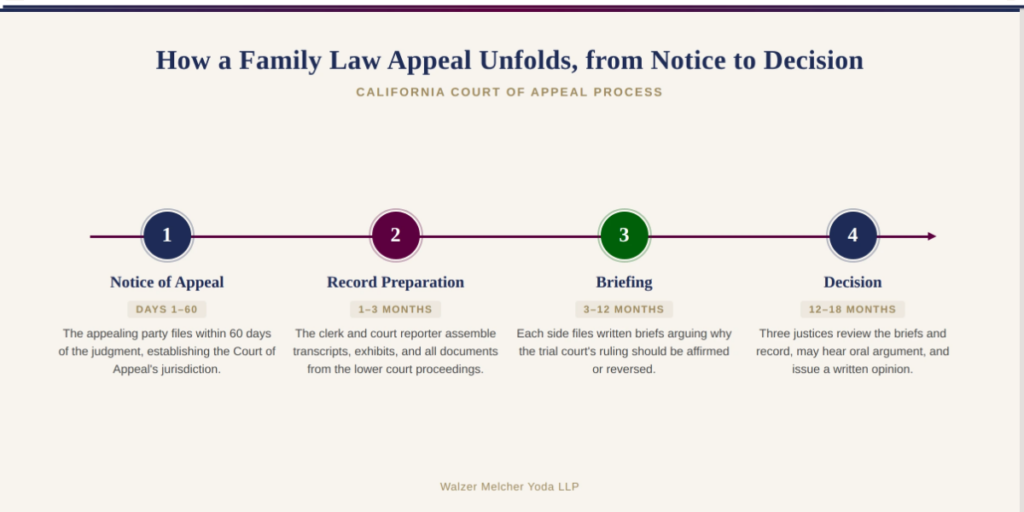
Phase 1: Notice of Appeal & Statement of Decision (Day 1-60). The process begins when the appellant files a notice of appeal with the superior court. The appellate clock typically begins upon service of the Notice of Entry of Judgment, triggering a strict 60-day jurisdictional deadline. If this deadline passes, the right to appeal is lost regardless of the strength of the underlying legal argument. Certain post-trial motions, such as a motion for a new trial under Code of Civil Procedure section 657 or a motion to vacate under section 663, can extend the deadline, but the rules governing these extensions are technical and strictly enforced. Crucially, requesting a formal Statement of Decision during trial forces the judge to explain the legal and factual basis for the ruling, laying the essential foundation to establish reversible error on appeal.
Phase 2: Record Preparation (1-3 months). The appellant designates the record on appeal, which typically includes the clerk’s transcript (all filed documents, minute orders, and the judgment) and the reporter’s transcript (the verbatim record of testimony and argument). In complex business owner divorce cases where expert testimony on valuation spanned multiple days, the reporter’s transcript alone can run thousands of pages. Selecting what to include, and what to leave out, is a strategic decision that shapes the entire appeal.
Phase 3: Briefing (3-12 months). The appellant’s opening brief must be filed within 40 days after the record is filed. The respondent then has 30 days for a response brief, and the appellant has 20 days for a reply. Extensions are common but not automatic. The opening brief is the centerpiece of the appeal. It must identify the specific error, cite the record showing where the error occurred, apply the correct standard of review, and demonstrate prejudice. In family law, where trial courts exercise broad discretion on support, custody, and property characterization, the briefing must show that the court acted outside the bounds of that discretion or misapplied a legal standard, not simply that another judge might have decided differently.
Phase 4: Decision (12-18 months from briefing). After briefing is complete, the Court of Appeal may schedule oral argument or submit the case on the briefs. The court then issues a written opinion, which may affirm the trial court’s decision, reverse it, or reverse and remand for further proceedings on specific issues. Under California Rules of Court, the court has 90 days after submission to file its decision, though complex cases sometimes take longer. The total elapsed time from filing the notice of appeal to receiving a decision is typically 12 to 24 months.
The Firm's Appellate Record: Published Opinions and Landmark Rulings
Walzer Melcher Yoda LLP’s appellate practice has produced published opinions at every level of the California court system, including the California Supreme Court. These are not routine procedural appeals. They are cases that established or clarified the law for every family law practitioner and litigant in the state.
In Marriage of Valli (2014) 58 Cal.4th 1396, Christopher C. Melcher and Peter M. Walzer represented Frankie Valli before the California Supreme Court in a dispute over the characterization of a life insurance policy. The Court of Appeal had ruled that an interspousal transfer of a life insurance policy was valid based on the form of title. The Supreme Court reversed, holding that a transmutation of community property requires an express written declaration under Family Code section 852, regardless of how title is held. This decision reshaped how title presumptions and transmutation law apply across all community property disputes in California.
In In re Brace (2020) 9 Cal.5th 903, Christopher C. Melcher argued before the California Supreme Court as amicus curiae on a certified question from the Ninth Circuit involving the intersection of community property law and bankruptcy. The case asked whether property purchased with community funds and held in joint tenancy is community property or separate property. The Supreme Court held that the community property presumption under Family Code section 760 prevails over the form-of-title presumption in Evidence Code section 662, and that for property acquired after 1985, a joint tenancy deed alone cannot transmute community property into separate property without an express written declaration under Family Code section 852. The decision resolved a long-standing conflict between California’s community property statutes and title-based presumptions, with direct implications for property characterization disputes in divorce and bankruptcy proceedings statewide.
In Marriage of Patel (2025) 117 Cal.App.5th 262, Christopher C. Melcher, Steven K. Yoda, and Cynthia J. Ponce obtained a published decision establishing a question of first impression: whether a respondent’s consent is required before a court may enter a judgment of legal separation. The Court of Appeal held that it is, resolving an open question under Family Code section 2346 that had created conflicting outcomes across trial courts statewide.
In Marriage of Goldman (2025) 107 Cal.App.5th 1258, Christopher C. Melcher and Cynthia J. Ponce successfully defended against a breach of fiduciary duty claim valued at over one billion dollars by establishing that laches is a valid equitable defense to the enforcement of family law property judgments, a holding with significant implications for post-judgment disputes involving delayed claims.
These cases illustrate what appellate work at this level requires: the ability to identify legal questions that matter beyond the immediate case, the resources to brief them at a level that earns publication, and the credibility with the appellate bench that comes from consistent, high-quality advocacy over decades.
Family Law Appeals FAQs
A family law appeal is a proceeding in which the California Court of Appeal reviews a trial court's final ruling for legal error, without hearing new evidence or retrying the facts. The appellate court examines the existing record, the trial judge's reasoning, and the applicable law to determine whether the decision should stand, be reversed, or be sent back for further proceedings. An appeal is governed by Code of Civil Procedure section 904.1 and is subject to strict filing deadlines. When complex financial issues such as business valuation in divorce or executive compensation are at stake, the precision of the appellate analysis can determine whether a multi-million-dollar ruling survives or is overturned.
You must file a notice of appeal within 60 days after the clerk or a party serves notice of entry of the judgment or appealable order. If no such notice is served, the outer deadline is 180 days from entry of the judgment. These deadlines are jurisdictional under California Rules of Court, Rule 8.104, meaning the court has no discretion to extend them once they expire. Certain post-judgment motions can toll or extend the deadline, but the rules governing those extensions are technical. At Walzer Melcher Yoda LLP, our Chambers & Partners Band 1 high-net-worth family law attorneys advise clients to consult appellate counsel immediately after an unfavorable ruling to preserve every available deadline.
The most common grounds are misapplication of law, abuse of discretion, lack of substantial evidence supporting factual findings, and denial of due process. The appellate court does not re-weigh the evidence or second-guess credibility determinations. Instead, it asks whether the trial judge applied the correct legal standard and whether the outcome falls within the range of results the law permits. Under Article VI, Section 13 of the California Constitution, the error must also be prejudicial, meaning it probably affected the outcome. An error that did not change the result is not reversible. In spousal support (alimony) cases, for example, a trial court's failure to properly weigh the factors under Family Code section 4320 can constitute an abuse of discretion warranting reversal if the resulting award is not supported by the evidence.
Temporary orders issued before the final judgment are generally not directly appealable, but they can be challenged through an extraordinary writ proceeding. Under California law, most interlocutory orders in family law do not qualify as appealable orders under Code of Civil Procedure section 904.1. A writ of mandate or writ of prohibition asks the Court of Appeal to review the order immediately, without waiting for a final judgment. The court is not required to accept the writ, and the standard for relief is high: the petitioner must show that the trial court's order was clearly erroneous and that waiting for a final judgment would cause irreparable harm with no adequate later remedy. In contested custody disputes involving potential relocation or jurisdictional challenges, writ proceedings may be the only effective path to appellate review before a child is moved or a status quo is established that becomes difficult to reverse.
Abuse of discretion means the appellate court will overturn a ruling only if no reasonable judge could have reached the same result on the evidence presented, while de novo review means the appellate court independently decides the legal question with no deference to the trial judge's conclusion. Most discretionary family law rulings, including custody, visitation, and support determinations, are reviewed for abuse of discretion. This is a high bar for the appellant to clear, because it requires showing that the trial court acted arbitrarily, capriciously, or in a manner that exceeds the bounds of reason. Questions of statutory interpretation, contract construction (including prenuptial and postnuptial agreements), and constitutional issues receive de novo review, giving the appellate court a free hand to reach its own conclusion. The standard of review applied to each issue on appeal often determines whether the appeal succeeds or fails.
The appellate court can affirm the trial court's decision, reverse it outright, or reverse and remand the case back to the trial court for a new hearing on specific issues. In most family law appeals involving property division or support calculations, the Court of Appeal identifies the legal error and sends the case back to the trial court with instructions to reconsider the issue under the correct legal framework. In rare cases, where the facts are undisputed and only one result is legally permissible, the appellate court may direct the trial court to enter a specific order. The distinction matters for case strategy, because a remand means additional time and expense at the trial level, while a directed reversal provides a definitive resolution.
Appellate costs include court filing fees, the expense of preparing the clerk's transcript and reporter's transcript, and the legal fees for researching, briefing, and arguing the appeal, which in complex family law cases can be substantial. The reporter's transcript alone, in a case involving multi-day trial testimony, can cost several thousand dollars. Legal fees reflect the intensity of the work: appellate briefing requires a different skill set than trial advocacy, with extensive legal research, record analysis, and persuasive writing at a level directed to an audience of appellate justices, not a single trial judge. Under Family Code sections 2030 and 2032, the court may order one spouse to contribute to the other's attorney's fees on appeal based on the parties' respective financial circumstances, a provision that can make appellate representation accessible when one spouse controls the marital assets. Our attorneys have obtained fee awards on appeal for clients as celebrity divorce lawyers handling high-profile cases.
Filing an appeal does not automatically stay enforcement of a family law order, but you can request a stay from the trial court or seek a writ of supersedeas from the Court of Appeal. Under Code of Civil Procedure sections 917.1 through 917.9, certain money judgments can be stayed by posting a bond, but family law support orders are treated differently: child support and spousal support obligations generally remain enforceable during the appeal unless the court specifically orders a stay. Property division orders involving asset transfers or business interests may be stayed to prevent irreversible harm, but the party seeking the stay must demonstrate a likelihood of success on appeal and that the balance of hardship favors a stay. In complex cases involving ongoing business operations or tax consequences of divorce, obtaining a stay can be as strategically important as winning the appeal itself.
Appellate skill applies equally to challenging a trial court error and to defending a favorable ruling against an opponent's appeal. The respondent's brief is not simply a restatement of the trial court's reasoning. Effective respondent advocacy requires identifying weaknesses in the appellant's framing, reinforcing the factual record that supports the trial court's exercise of discretion, and presenting alternative grounds for affirmance that the trial court may not have articulated. At Walzer Melcher Yoda LLP, our practice includes representing clients who prevailed at trial and now face an appeal, as well as attorneys from other firms who refer their clients to us for the appellate phase because the case requires an appellate law specialist with specific family law expertise. Christopher C. Melcher's dual certification by the California State Bar in both family law and appellate law allows the firm to offer a combination of substantive knowledge and appellate technique that pure appellate shops or pure family law trial firms cannot match.
Yes, a final custody order issued as part of a judgment of dissolution or a final custody determination is directly appealable under Code of Civil Procedure section 904.1. The appeal must be filed within 60 days of service of notice of entry of the order. On appeal, the Court of Appeal reviews the trial court's custody determination for abuse of discretion, which means the ruling will stand unless the appellant can demonstrate that no reasonable judge could have reached the same result on the evidence presented. This is a high standard, but trial courts do make reversible errors, including failing to consider required statutory factors under Family Code section 3011, relying on inadmissible evidence, or denying a party a meaningful opportunity to be heard. If the custody order is temporary or pendente lite rather than final, it is not directly appealable, but it can be challenged through a writ of mandate. Whether you are seeking to overturn an unfavorable custody ruling or defending a favorable one on appeal, the appellate strategy must be tailored to the specific standard of review and the factual record from trial.
Yes, a final judgment of dissolution, including its rulings on property division, spousal support, custody, and attorney's fees, is appealable under Code of Civil Procedure section 904.1. The notice of appeal must be filed within 60 days of service of the notice of entry of judgment. An appeal does not re-open the trial or allow new evidence. The Court of Appeal reviews the existing record to determine whether the trial court committed legal error or abused its discretion. Common grounds for appealing a divorce decree include mischaracterization of community or separate property, miscalculation of support based on incomplete income evidence, and failure to apply the correct legal standard to a contested issue. Not every unfavorable ruling is reversible, because the appellate court must also find that the error was prejudicial, meaning it probably changed the outcome. Consulting a family law appeal attorney early, ideally before post-trial motion deadlines expire, preserves the widest range of options.
The total time from filing a notice of appeal to receiving the Court of Appeal's decision is typically 12 to 24 months, though the timeline varies based on the complexity of the record and the court's calendar. The process moves through four phases: filing the notice of appeal (within 60 days of the judgment), preparing the appellate record (1 to 3 months), briefing (3 to 6 months for all briefs to be filed), and the court's review and decision (which can take 6 to 18 months after briefing is complete). Under California Rules of Court, the court has 90 days after submission to file its decision, but complex family law cases involving multi-day trial records, extensive expert testimony on business valuation or support calculations, and multiple contested issues often take longer. Emergency writ proceedings operate on a compressed timeline and can produce a ruling within weeks when irreparable harm is at stake. Throughout the appeal, existing trial court orders on custody and support generally remain in effect unless a stay is obtained.
Appellate Counsel for High-Stakes Family Law Cases in Los Angeles
As appellate lawyers in Los Angeles with dual certification in family law and appellate law, we bring a combination of trial-level family law experience and appellate specialization that the complexity of high-net-worth family cases demands. Christopher C. Melcher is one of the only practicing attorneys in California certified by the State Bar as a specialist in both family law and appellate law, a dual designation that reflects thousands of hours of continuing education, peer review, and demonstrated proficiency at both the trial and appellate levels. Peter M. Walzer and Steven K. Yoda bring decades of trial experience that informs the firm’s ability to evaluate which issues were properly preserved, which rulings present viable grounds for appeal, and which cases are better resolved through post-trial motion practice rather than the appellate process.
Based out of our primary office in Los Angeles, California, our practice frequently appears before the Second District Court of Appeal in Los Angeles, Ventura, and Santa Barbara, the First District Court of Appeal covering San Francisco and San Mateo, the Third District Court of Appeal in Sacramento, the Fourth District Court of Appeal serving Orange, San Diego, and Riverside counties, the Fifth District Court of Appeal in Fresno and Kern counties, and the Sixth District Court of Appeal serving Santa Clara and Monterey. Whether you need a top-rated Orange County family law appeal lawyer or representation for a complex Ventura County divorce appeal, our firm provides the specialized appellate advocacy required across all of California.
For cases involving cross-border custody, support enforcement across jurisdictions, or international treaty obligations under the Hague Convention, our experience as international family law attorneys provides the substantive grounding that appellate courts expect when reviewing jurisdictional and choice-of-law issues that most domestic practitioners encounter only in theory.
If you have received an unfavorable ruling in a California family law matter, or if you need to defend a trial court victory on appeal, contact our office to discuss the strength of your appellate position and the timeline for action. As a divorce appeal lawyer and family law appeal attorney in California, our firm evaluates every case for viable grounds before recommending whether to proceed.
Contact Us
Connect immediately with our confidential client intake team to review your case.
Our Family Law Appeals
In re Marriage of McConnell and Jahnke (2026) _ Cal.App.5th _ (A172525)
Christopher C. Melcher, a Chambers & Partners Band 1 high-net-worth family law attorney at Walzer Melcher Yoda LLP, served as appellate counsel for Suzanne Jahnke in this family law appeal by her ex-husband. The parties settled their divorce by marital settlement agreement, awarding a ranch property to Wife as part of the property division, “together with the debt thereon.” There was no express provision for Husband to be removed as a debtor from the joint mortgage, unlike other provisions in the agreement that had details about handling joint debt. Husband argued that the parties intended for him to be removed as a debtor. Christopher C. Melcher successfully argued that implied terms are not allowed for a contract unless necessary to effectuate the purpose of the agreement, and that removing Husband from the debt was not necessary for the ranch to be awarded to Wife. The express terms of the agreement required her to be responsible for paying the debt, and there was no requirement to pay off the loan early or sell the property to have him removed as a co-borrower. The court of appeal agreed and published that part of its opinion.
In re Marriage of Patel (2025) 117 Cal.App.5th 262
Christopher C. Melcher, Steven K. Yoda, and Cynthia J. Ponce of Walzer Melcher Yoda LLP, recognized as a 2026 Tier 1 Best Law Firm® for Family Law in Los Angeles and Band 1 by Chambers & Partners for high-net-worth family/matrimonial law, represented the Husband in defeating an appeal by the Wife of the dismissal of her action for legal separation. Wife filed a rather than an action for legal separation, rather than one for dissolution of marriage, because she did not meet the 6-month residency requirement to file for divorce in California. The trial court dismissed the case when Steven K. Yoda pointed out that our client did not consent to a judgment of legal separation, which is a requirement before any such judgment be entered. After her case was dismissed and she appealed, Christopher C. Melcher successfully defended the dismissal. The court of appeal, in a case of first impression, held that consent must be given by the respondent to a judgment of legal separation as required by statute.
In re Marriage of Goldman (2025) 107 Cal.App.5th 1258 (Goldman I)
Christopher C. Melcher, a Chambers & Partners Band 1 high-net-worth family law attorney at Walzer Melcher Yoda LLP, and Cynthia J. Ponce, recognized as a Key Team Lawyer in California Family Law by The Legal 500, represented the Husband in this appeal by a former Wife, who claimed that she was owed upwards of $1 billion from an alleged breach of their marital settlement agreement many years earlier. At trial, Husband raised the defense of laches, which is an equitable doctrine that prevents a party from making a claim when there has been an unreasonable delay that has prejudiced the other party. The trial court denied Wife’s claim due to laches. On appeal, Wife argued that laches does not apply as a defense to a family law judgment. Christopher C. Melcher successfully argued that laches is a legally available defense to a family law judgment that awards property to a party.
In re Marriage of Moore (2024) 102 Cal.App.5th 1275
Christopher C. Melcher and Cynthia J. Ponce of Walzer Melcher Yoda LLP, recognized as a 2026 Tier 1 Best Law Firm® for Family Law in Los Angeles and Band 1 by Chambers & Partners for high-net-worth family/matrimonial law, represented the wife in a dispute over the discovery of records from the company that the husband founded. The company objected to a deposition subpoena for the production of the records, claiming among other things that the request was filed beyond the deadline imposed by law. We successfully argued that the order of compelling the production of documents was valid. In this published decision, the court of appeal also decided whether expenses occurred to mediate a discovery dispute are recoverable under the Civil Discovery Act.
In re Marriage of Moore, Rocket Lawyer Inc. (2024) 102 Cal.App.5th 1275
Christopher C. Melcher and Cynthia J. Ponce of Walzer Melcher Yoda LLP, recognized as a 2026 Tier 1 Best Law Firm® for Family Law in Los Angeles and Band 1 by Chambers & Partners for high-net-worth family/matrimonial law, represented the former Wife in this appeal by nonparty corporations, which claimed that they should not have to pay $25,000 each in discovery sanctions for resisting subpoenas tied to the marital estate. At trial, Wife sought monetary sanctions under the Civil Discovery Act, arguing that the corporations’ failure to comply with her subpoenas forced her to incur substantial legal fees. The trial court agreed and granted Wife’s motion for sanctions. On appeal, the corporations argued that fees incurred during voluntary mediation after a motion to compel is filed cannot legally be included in a discovery sanctions award. Christopher C. Melcher successfully defended the core discovery orders but the appellate court established a new precedent, ruling that while pre-motion meet-and-confer costs are fully compensable, post-motion mediation expenses must be excluded from a discovery sanctions award.
In re Marriage of Nakamuto and Hsu (2022) 79 Cal.App.5th 457 (G059108), amicus request for publication
In this appeal, the husband challenged two rulings. First the husband claimed that the trial court abused its discretion in denying his request for attorneys fees for the trial in his marital dissolution action. The second ruling was a denial of his request for attorneys fees for the appeal that he had filed as to the judgment that was rendered at the end of the trial. The court of appeal held that the trial court did not abuse its discretion in denying trial court fees because the husband over-litigated the divorce by making unmeritorious claims. The court also held that there was no abuse of discretion in denying fees for the appeal because the husband failed to establish any reasonable basis to appeal the judgment. Christopher C. Melcher of Walzer Melcher Yoda LLP, was not involved in the underlying proceedings, but asked the court of appeal to publish its decision so that it could be used as precedent for other cases in family court. The court of appeal agreed to publish its decision based on his request. This case is important to show that when a party makes claims that are unsupported by the evidence, the court may deny a request for fees to that party.
Marriage of Zucker (2022) 75 Cal.App.5th 1025
The court held that a premarital agreement made in 1994 was unconscionable under a new test it created that contradicts the version of the California Uniform Premarital Agreement Action that applies to agreements of that vintage. Top family law attorney Christopher C. Melcher requested the California Supreme Court to depublish the opinion.
Safarian v. Govgassian (2020), 2nd District
The trial court found that a marital settlement agreement failed to divide the spouse’s interest in a judgment against third parties, using the stringent test in Family Code section 852 for transmutations instead of the more relaxed rule in section 2550 for marital settlement agreements. The court of appeal reversed but also used the transmutation standard in its analysis. Top family law attorney Christopher C. Melcher, on behalf of the Association of Certified Family Law Specialists (ACFLS), asked the California Supreme Court to depublish the decision. Read his letter here.
ACFLS Request for Depublication: May 19, 2020 – Safarian v. Govgassian
In re Brace (California Supreme Court)
Top family law attorney Christopher C. Melcher is Amicus Counsel in Marriage of Brace, a matter pending before the California Supreme Court.
The 9th Circuit Court of Appeal asked the California Supreme Court to answer whether, under California law, a property acquired by spouses in joint tenancy is community property or if the spouses hold equal separate property interests in the joint tenancy.
Christopher C. Melcher’s Amicus Brief
Request to Divide Oral Argument Time, Executed
Monasky v. Taglieri (2020) 139 S. Ct. 2691
The mother (Monasky) took an infant away from the father (Taglieri). The mother and father were both living in Italy. Mom took the baby to the US. Dad filed an action to return the child to Italy.
The Hague Convention “addresses a pressing and never-ceasing policy problem—the abductions of children by one half of an unhappy couple” in order to gain an advantage in the child-custody determination accompanying the marriage’s dissolution. When one parent unilaterally moves the child within a nation, that nation’s domestic law is capable of resolving the dispute. But when a child is abducted across international borders, an agreement among nations was needed to provide a prompt and effective mechanism for resolving the dispute.
“The Convention’s mission is basic: to return children ‘to the State of their habitual residence,’ to require any custody disputes to be resolved in that country, and to discourage parents from taking matters into their own hands by abducting a child.”
“Habitual residence” is thus the linchpin of the Convention’s protections— the Convention is “based on the principle that the best interests of the child are well served when decisions regarding custody rights are made in the country of habitual residence.”
This case presents two questions regarding the Convention’s habitual residence standard—the standard of appellate review for district courts’ determinations of habitual residence; and whether an actual agreement between the parents regarding the place where the child will be raised is a necessary prerequisite to establishing the child’s habitual residence.
Top family law attorney Peter M. Walzer filed an amicus brief for the American Academy of Matrimonial Lawyers(AAML) supporting the father’s position in this appeal.
Grimes v. Mou (2020), 6th District
The wife in this appeal claimed the family court should have characterized money she borrowed from her family in China as belonging to her family members, not as community property. Wife also claimed the award of spousal support was too low to meet the marital standard of living. Top family law attorneys Christopher C. Melcher and Steven K. Yoda successfully defended those rulings on appeal on behalf of the husband. The Court of Appeal affirmed the decision in full.
Marriage of M.S. v. M.R.S. (2019), 1st District
A mother of young children wanted to relocate them from San Francisco to Denmark because the mother was hearing impaired and believed there were more resources for her to use Danish Sign Language. The family court denied the move and the mother appealed, claiming the judge did not give proper weight to her disability. Top divorce attorney Christopher C. Melcher represented the father, a founder of a publicly traded company. Christopher was able to have the case name anonymized and information redacted from the appeal to protect the privacy of the family. After briefing, the mother voluntarily dismissed the appeal.
Hunt v. Hunt (2019), 1st District
This appeal involved how to calculate child support when a tax return for the last year had not been filed. The wife claimed that a mistake was made by setting support on the husband’s base salary and ordering him to pay additional child support according to what his tax return showed as income when filed. Top divorce attorney Christopher C. Melcher respresented the husband. After breifing the appeal, the parties settled and the appeal was dismissed.
W.M. v. V.A. (2019) 30 Cal.App.5th 64
Top family law attorney Christopher C. Melcher represented the father of a child who had petitioned the Los Angeles Superior Court for child custody orders. The mother, a former number 1 tennis player, claimed that the Republic of Belarus had jurisdiction over the child. The trial court ruled in father of the mother. Chris was hired and sought an emergency stay by the Court of Appeal to prevent the mother from removing the child from California, which was granted pending the outcome of my client’s appeal. The appellate court held that California had jurisdiction.
Petition for Writ of Supersedeas
Y.R. v. A.F. (2017) 9 Cal. App. 5th 974
Christopher C. Melcher and Steven K. Yoda appealed a child support order involving a famous film director who made over 300,000 dollars per month in income but was only ordered to pay 8,500 dollars in child support. We convinced the Court of Appeal that the trial court made an error in awarding such a low amount of support and had the case sent back for a new hearing.
Marriage of Chapman (2016) 3 Cal.App.5th 719
Steven K. Yoda and Christopher C. Melcher appealed an order requiring a United States service member to pay part of his combat related service pay to his former wife as a division of community property. We convinced the Court of Appeal that the trial court lacked authority to divide that benefit under federal law.
Marriage of Moman (2015), 3rd District
Christopher C. Melcher is amicus curiae in this appeal, which raises the issue (1) whether the trial court has statutory authority to strike a timely responsive pleading of a party and enter that party’s default in a family law action for failure to comply with the disclosure requirements of the Family Code , and (2) whether the trial court possesses the inherent authority to impose such a sanction in the absence of express statutory authority.
Marriage of Kaiman (2015), 2nd District, unpublished
Christopher C. Melcher, Leena S. Hingnikar, and Scott M. Klopert were appellant counsel for Husband. Wife appealed a ruling against her on a breach of fiduciary duty claim. Husband moved to dismiss the appeal because the order she appealed from was not appealable. The Court of Appeal dismissed the appeal.
Marriage of Valli (2014) 58 Cal.4th 1396
Christopher C. Melcher and Peter M. Walzer were co-appellate counsel with Garrett C. Dailey on this successful appeal to the California Supreme Court. Chris was the lead trial counsel for Frankie Valli in the underlying divorce action. One of the issues at phase three of the trial was the character, division, and valuation of a life insurance policy Frankie purchased during marriage on his life with community funds. Randy Valli was named the owner of the policy for income tax purposes and argued that the policy was her separate property because it was titled in her name. Frankie countered that the policy was bought during marriage with community property, so it is community property. The trial court agreed with Husband and awarded the policy to Husband as community property. Randy appealed and convinced the Court of Appeal that the policy was her separate property because it was titled in her name. Frankie petitioned for review and the California Supreme Court reversed, holding that the trial court properly characterized the policy as community property.
Marriage of Lappe (2014) 232 Cal. App. 4th 774
Christopher C. Melcher served as co-appellate counsel with James M. Donovan, Michael Glenn, Anthony D. Storm in opposing a writ petition filed by Wife regarding mediation confidentiality. Husband and Wife settled the marital dispute in mediation. They prepared and exchanged the required financial disclosures in mediation. Wife later moved to set aside the settlement agreement, claiming lack of disclosure and other grounds. Wife demanded that Husband produce a copy of the disclosures that were prepared in mediation. Husband objected because any documents prepared in the course of mediation are confidential and are not subject to discovery. The trial court agreed with Husband’s position, but the Court of Appeal reversed.
Opposition to Petition for Writ
Decision by the Court of Appeal, Second District
Marriage of Aitchison (2014), 1st District, unpublished
Christopher C. Melcher and Anthony D. Storm were substituted in as appellant counsel for Husband to file a reply brief on his cross-appeal. The case involved the validity of a premarital agreement, which the trial court ruled was invalid. The major issue was whether an award of attorney’s fees to Wife was sufficient. The Court of Appeal affirmed the orders.
Marriage of Carlson (2014), 1st District, unpublished
Christopher C. Melcher and Anthony D. Storm were appellate counsel for Husband in opposing Wife’s appeal of an order that her trust income should be counted for purposes of making a support order against her. Wife dismissed eventually her appeal.
Marriage of Martin (2014), 1st District, unpublished
Christopher C. Melcher and Shannon Stein were appellate counsel for Husband in opposition to Wife’s appeal of an order allowing withdrawal of funds from a 401k account. Husband filed a motion to dismiss the appeal, and Wife agreed to dismiss the appeal.
Maurizio R. v. L.C. (2011) 201 Cal.App.4th 616
Christopher C. Melcher and Jennifer M. Riemer were the appellate counsel for Maurizo R., who sought the return of his son who had been kidnapped from Italy by the child’s mother. The trial court denied Maurizio’s application to return the child under The Hague Convention on the Civil Aspects of International Child Abduction, finding that there would be a grave risk of harm to the child if returned to Italy. The Court of Appeal disagreed and held that the trial court was required to order the child’s immediate return to Italy, for custody proceedings in that country.
Opening Brief
Reply Brief
Decision by the Court of Appeal, Second District
Blair v. Blair (2011), 2nd District, unpublished
Christopher C. Melcher and Jennifer M. Riemer were appellant counsel for Wife in opposing Husband’s appeal. Husband claimed that the trial court erred when it issued evidentiary sanctions against him for his attorney’s negligent failure to file a witness list and exhibit list for trial, as required by local court rules in effect at that time. The Court of Appeal held that Husband failed to show any prejudice and affirmed the decision.
Montenegro v. Diaz (2001) 26 Cal.4th 249
In a story that has become all too familiar, Deborah Diaz and Alex Montenegro could not agree on custody and visitation over their son, Gregory. During the child custody proceedings, Diaz and Montenegro entered into various stipulations, confirmed by the trial court, “resolving” their disputes over Gregory. In the last such stipulation, Diaz and Montenegro agreed to joint legal custody of Gregory, with Diaz having primary physical custody.
When Gregory was to start kindergarten, however, they were unable to resolve their differences and asked the trial court to modify its last stipulated custody order. After an adversarial hearing, the trial court awarded primary physical custody to Montenegro based on the “best interests” of the child. The Court of Appeal reversed, concluding that the trial court applied the wrong standard.
Finding that two of the stipulated orders were final judicial custody determinations, the Court of Appeal held that the custody arrangement was subject to modification only if Montenegro established a significant change in circumstances. The California Supreme Court reversed the appellate court and held that the trial court properly applied the best interest standard, rather than the changed circumstance rule.
Although the Supreme Court concluded that stipulated custody orders may be final judicial custody determinations for purposes of the changed circumstance rule, it also recognized that many stipulated custody orders not intended to be final judgments.
After this case attorneys representing parties in custody cases were careful to make sure a custody order that was intended to be “permanent” was so designated in the stipulated order or if contested, that the court hearing the matter found or the record that the order was a permanent order.
Our founding partner, Peter M. Walzer, appeared as Amici Curiae on behalf of Minor Child with the following people and organizations: Leslie Ellen Shear, Encino, for Levitt and Quinn Family Law Center, Inc., Association of Certified Family Law Specialists, Inc., Los Angeles, Harold J. Cohn, Douglas Darnell, Robin Drapkin, Lyn Greenberg, Lee Lawless, San Diego, Hugh McIsaac, Nancy Oleson, Philip M. Stahl, Richard Warshak, Leonard Weiler, San Ramon, and Linda Wisotsky.