Miotke: Premarital Agreements
Title:In re Marriage of Miotke (Premarital Agreements) Court:California Court of Appeal, Sixth District Citation:Published Opinion,

Prenups, postnups, and cohabitation agreements allow couples to define their own financial terms rather than leaving property division and support to default California law.
At Walzer Melcher Yoda LLP, our Chambers & Partners Band 1 high-net-worth family law attorneys specialize in insulating pre-marital wealth. For business owners, executives, and high-earning individuals, our advocates deliver precision-engineered pre-marital business valuation protection and strategic counsel for protecting corporate equity in divorce.
Premarital agreements, more commonly known as prenups, are often treated as a catch-all term for a much broader category of planning. In California, prenups, postnups, and cohabitation agreements each sit under a distinct area of law, and each carries its own standard for negotiation, disclosure, and enforcement. A prenup is negotiated before the marriage, while the parties are still dealing with one another at arm’s length. A postnup is negotiated afterward, once the fiduciary duty spouses owe each other has already attached, which is why California courts scrutinize a postnup far more closely than a prenup. A cohabitation agreement exists outside marriage altogether: rather than falling under the Family Code, it is treated as an ordinary contract between two people who never acquired the property or support rights that marriage would have conferred.
Recognized in the 2026 edition of Best Law Firms® with a Tier 1 ranking for Family Law in Los Angeles, and Band 1 by Chambers & Partners for high-net-worth family/matrimonial work, our attorneys are retained specifically for this precision: identifying the correct instrument, structuring it to withstand scrutiny, and timing its execution so it holds when it matters most.
Key issues we handle across all three agreement types:
A valid agreement can replace California's default 50/50 community property system with terms the parties choose for themselves.
Shielding a business, equity, or professional practice built before marriage from acquiring an unintended community interest.
Capping, limiting, or in some cases waiving spousal support, subject to strict independent-counsel requirements.
Keeping a family home, vacation property, or inheritance classified as separate property.
Postnups in particular start from a legal presumption against the spouse who benefits, which has to be affirmatively overcome.
Cohabitation agreements are often the only way for unmarried partners to secure property or support protections that marriage provides automatically.
Prenups in California are governed by the Uniform Premarital Agreement Act, codified at Family Code sections §§ 1610 through 1617. When securing substantial assets, a custom-tailored high-net-worth prenuptial agreement can insulate complex portfolios as separate property under Family Code section §770, safeguarding venture capital, partnership shares, and executive compensation separate property structures from future community division. A valid prenup can designate property as separate under Family Code section §770, restructure how community property will be divided under section §2550, and limit or waive spousal support under Family Code section §1612, though a support waiver is only enforceable if the party against whom it’s enforced was represented by independent legal counsel at the time of signing.
Since a 2020 amendment to Family Code section §1615, every prenup, regardless of whether both parties are represented by attorneys, requires at least seven calendar days between the date a party receives the final version of the agreement and the date it’s signed. That 7-day rule is mechanical and courts apply it strictly: an agreement signed even one day early can be challenged as involuntary regardless of how fair its terms are. This is exactly why we tell clients to start the process months, not weeks, before a wedding date.
Christopher C. Melcher literally wrote the treatise on premarital agreements used by family law practitioners across California, Premarital Agreements: Negotiation, Preparation and Litigation (LexisNexis, Complex Issues in California Family Law series). Peter M. Walzer, whom Chambers & Partners has recognized as “the godfather of prenups” alongside his Band 1 ranking in its High Net Worth Guide for Family Law, brings that same depth to the negotiation side, having spent decades counseling couples through the conversation before a prenup is ever signed, not just litigating what happens if one fails. That focus is reflected in his video, Discussing Prenups With Your Fiancé: Uncover Trust Issues Before Marriage.
Rigid Calendar Requirements: California Family Code Section §1615(c) enforces an absolute statutory floor, requiring seven full calendar days between the presentation of the finalized agreement text and the actual date of execution.
Zero Judicial Discretion: Family law judges interpret this timeline mechanically with no equity-based leeway. Executing an agreement even a single day early triggers a statutory presumption of involuntariness, which routinely invalidates agreements during high-net-worth dissolutions.
Strategic Risk Mitigation: To safeguard corporate interests, venture equity, and substantial inherited wealth, Walzer Melcher Yoda LLP initiates financial disclosures months in advance, ensuring clients comfortably clear this mandatory reflection window without wedding-day pressure.
A postnup is signed after the wedding, and that timing changes everything about how it’s reviewed. Spouses already owe each other a fiduciary duty under Family Code section §721, the same duty business partners owe one another, which means any postnup provision that benefits one spouse to the other’s detriment is presumed to be a Family Code §721 undue influence violation. The spouse seeking to enforce that provision bears the burden of proving, with clear and convincing evidence, that the agreement was fair and that both sides fully disclosed their finances. If challenged during a dissolution, an unrepresented or uninformed spouse may allege a fiduciary duty breach California court standard to set the contract aside.
Postnups are commonly used to reclassify property, for example designating an inheritance, a newly formed business, or a large gift as one spouse’s separate property. Any change in how property is characterized between spouses (a ‘transmutation’) must be in writing and satisfy the express-declaration requirement of Family Code section §852. Failing to adhere strictly to these marital property transmutation rules is one of the most common grounds for completely invalidating a prenuptial agreement or postnuptial contract in court.
California does not recognize common law marriage, and living together, even for decades, even with children, even with commingled finances, creates no automatic right to spousal support or a share of a partner’s property. The landmark case Marvin v. Marvin established that unmarried couples can still enforce express agreements, written or oral, to share property or provide support, and that courts may in some circumstances recognize an implied agreement from the parties’ conduct. In practice, an implied agreement is far harder to prove than a signed one.
A cohabitation agreement lets unmarried partners define, in writing, how property acquired during the relationship will be characterized, whether either partner is entitled to support if the relationship ends, and how jointly titled assets like a shared home will be divided. Because these agreements are evaluated under ordinary contract law rather than the Family Code, precise drafting matters even more than in a prenup: a court will look first at what the agreement actually says, not at any community property presumption, since none applies.
Prenups (premarital agreements) are signed before marriage under Family Code sections 1610 through 1617, while postnups (postmarital agreements) are signed after the wedding and are governed instead by the marital fiduciary duty standard in Family Code section 721. Because postnups are negotiated between spouses who already owe each other the highest duty of good faith, California courts scrutinize them far more closely than prenups, presuming undue influence whenever one spouse benefits at the other's expense.
California law requires at least seven calendar days between the date a party is presented with the final version of a premarital agreement and the date it's signed, regardless of whether that party is represented by counsel, under Family Code section 1615. This waiting period, effective January 1, 2020, exists to prevent last-minute pressure before a wedding, and an agreement signed inside that window can be challenged as involuntary years later.
Yes, Family Code section 1612 allows spouses to limit or fully waive spousal support in a premarital agreement, but a support waiver is unenforceable unless the party against whom it's enforced was represented by independent legal counsel at signing. That's a stricter standard than the rest of the agreement is held to, which is why we make sure every client waiving support has their own attorney memorialize that representation in writing.
A postnuptial agreement is enforceable if it is in writing, supported by full financial disclosure, and entered into voluntarily, but because spouses already owe each other a fiduciary duty under Family Code section 721, any provision that benefits one spouse at the other's expense is presumed to result from undue influence. Overcoming that presumption requires the enforcing spouse to prove, by clear and convincing evidence, that the transaction was fair and fully disclosed.
No, California does not recognize common law marriage, and unmarried couples have no automatic right to spousal support or a share of each other's property regardless of how long they live together. Under Marvin v. Marvin, unmarried partners can still enforce express written or oral agreements to share property or provide support, which is why a cohabitation agreement is often the only way to secure the protections marriage provides automatically.
A cohabitation agreement should specify how property acquired during the relationship will be characterized and divided, whether either partner is entitled to support if the relationship ends, and how jointly titled assets such as a shared home will be handled. Because these agreements rely on ordinary contract law rather than the Family Code, precise drafting matters even more than in a prenup, since a court will look first at the agreement's actual language rather than at any community property presumption.
Protecting a business you owned before marriage requires a premarital agreement that designates it as separate property under Family Code section 770, preventing a spouse from acquiring a community interest in its growth. Without that protection, courts apply the Pereira or Van Camp formulas to apportion how much of the business's increase in value belongs to the community, one of the most litigated and costly outcomes an unprotected business owner can face.
Yes, spouses can use a postnuptial agreement to transmute property from community to separate ownership, such as designating an inheritance or a newly formed business as one spouse's separate property, but the transmutation must be in writing and satisfy the express-declaration requirement of Family Code section 852. Because these agreements are signed after the fiduciary duty in section 721 has already attached, we build in the disclosure and independent-review safeguards a court will expect if the agreement is ever challenged.
Whether you are weeks from a wedding, years into a marriage and want to formalize a change in your finances, or building a life with a partner without marrying, the agreement you sign today is what a court will look to years from now, long after the conversation that led to it is a memory.
Based out of our primary office in Woodland Hills, we represent elite clients throughout the Greater Los Angeles area and across Southern California as a premier Orange County asset protection lawyer resource and a strategic Ventura County family law firm. Our cross-jurisdictional practice frequently handles complex marital contracts in San Diego, coordinates cross-county matters as a San Francisco prenuptial agreement attorney asset, and delivers sophisticated counsel for high-net-worth individuals throughout the entire state of California, while applying our deep experience in international family law to regularly structure complex marital contracts that safeguard multi-jurisdictional assets worldwide.
At Walzer Melcher Yoda LLP, Peter M. Walzer, Christopher C. Melcher, and Steven K. Yoda have drafted and litigated these agreements at every level of complexity, from straightforward prenups to contested postnuptial transmutations involving closely held businesses.
Recognized as a 2026 Tier 1 Best Law Firm® for Family Law in Los Angeles and Band 1 by Chambers & Partners for high-net-worth family/matrimonial law for over nine consecutive years, we bring the same forensic precision to drafting an agreement that we bring to litigating one, because the agreements most likely to hold up are the ones built by lawyers who also handle the cases where agreements fall apart.
If you’re planning a marriage, already married and want to formalize a financial understanding, or building a life with a partner you’re not marrying, the time to put an agreement in place is now, before a wedding date or a life event puts you under pressure to rush it.
Contact our office to schedule a confidential consultation. We will explain your options honestly and help you decide which type of agreement, if any, fits your situation.
Connect immediately with our confidential client intake team to review your case.
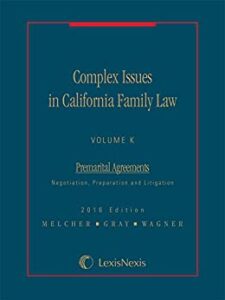 An authoritative book by top family law attorney Christopher C. Melcher that was published by LexisNexis, is part of a series of treatises called Complex Issues in California Family Law. Christopher C. Melcher commented on the Uniform Premarital and Marital Agreements Act (Not adopted by California). This model act treats premarital agreements and postmarital agreements under the same set of rules. The goal is to have clear and consistent laws for the enforcement of agreements between parties who are about to be married and for spouses to intact marriages.
 Title:In re Marriage of Miotke (Premarital Agreements) Court:California Court of Appeal, Sixth District Citation:Published Opinion,
Title:Sturm v. Moyer (Premarital Agreements; Fraudulent Transfers) Court:California Court of Appeal, Second District Citation:Published Opinion,